Nearly 1,000-Fold Increase: Zhejiang University Breaks Through Mass Production Bottleneck for Anti-Cancer Drug Vinblastine
Widely used in clinical practiceVinblastine (anti-neoplastic agent), has long been constrained by its extremely low natural abundance in plant sources (approximately 0.0001%), making commercial supply heavily reliant on large-scale cultivation and complex extraction processes.
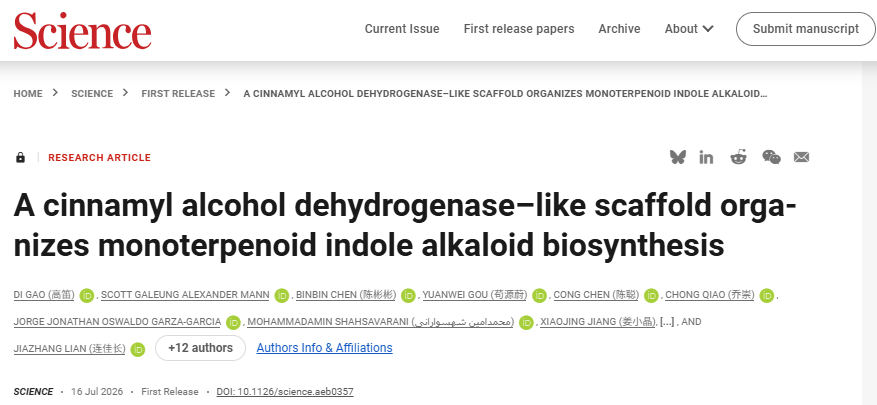
Recently, Zhejiang University, in collaboration with teams from the University of New Brunswick (Canada), Westlake University, and others,Sciencepublished their research findings online, reporting thatVinBLAST, a metabolic scaffold protein required for the biosynthesis of the first monoterpole indole alkaloidand based on this, increased the yield of vinorine, the direct precursor of vinblastine in *Saccharomyces cerevisiae*, to164.9 mg/L, increased by nearly1000times, the synthesis efficiency has surpassed that of natural periwinkle plants.
[Turning Yeast into "Drug Factories"]
This breakthrough relies onSynthetic biology technologyIn simple terms, scientists reprogram yeast genes like building blocks, transforming this microorganism once used for steamed buns and brewing into a "large-scale factory" capable of producing specific chemicals.
In earlier work, the Zhejiang University Lianjia team successfully introduced the post-modification pathway of vinblastine into *Saccharomyces cerevisiae*, but accumulation of key precursors has remained stalled atμg/L level, far from reaching the industrialization threshold.
Further traceability analysis indicates that the synthetic pathway in yeast cells exhibitsMulticompartmental distribution: catalyzes the formation of picroside aglyconeSGD enzymeLocalizes to the nucleus, while the downstream catalytic step requiresGS enzymePrimarily located in the cytoplasm. The nuclear envelope physically separates them, causing unstable intermediate metabolites to degrade significantly during transport between compartments. This spatial isolation is the fundamental barrier limiting yeast synthesis efficiency.
When comparing metabolic differences between Catharanthus roseus cell and yeast heterologous expression systems, the research team noticed one previously annotated asCAD2Gene for (cinnamyl alcohol dehydrogenase 2), traditionally thought to be involved in lignin monomer biosynthesis. However, through virus-induced gene silencing experiments,CAD2After downregulation, vinblastine production dropped sharply to 10% of the control level, suggesting a non-canonical role for this gene in the alkaloid pathway.
Genomic localization analysis further reveals thatCAD2andGSThe gene is tightly linked, and its expression level shows a significant positive correlation with alkaloid content in Catharanthus tissues. The protein encoded by this gene has been namedVinblastine。
[Molecular Bridge Mechanism: Spatial Restructuring and Enzyme Activity Doubling]
The joint team confirmed via protein-protein interaction and structural biology analyses that VinBLAST acts as a physical scaffold: its N-terminus binds the SGD enzyme, while its C-terminus binds the GS enzyme. This spatially "anchors" the two enzymes—previously segregated in the nucleus and cytoplasm—to the same microdomain. This reorganization significantly reduces compartmental diffusion loss of the iridoid aglycone intermediate and enhances GS catalytic efficiency by approximately {0} through proximity effects.24x.
The scaffold protein functions independently of its native dehydrogenase activity, acting solely as a structural scaffold. Co-expressing VinBLAST in engineered yeast strains with an integrated vinblastine precursor pathway increased vinblastine production to164.9 mg/LScalability potential has been demonstrated at the fermenter level.
[One "universal key" unlocks more possibilities]
Notably, the metabolic intermediate targeted by VinBLAST—genistein—isMonoterpene indole alkaloid family(CoversApproximately 700 typescore scaffold structure of natural products. Therefore, this scaffolding protein holds promise as a universal regulatory module for optimizing yeast-based biosynthesis systems of other clinically important alkaloids.
Moreover, VinBLAST is highly conserved across the plant kingdom. Homologous proteins in distantly related species such as tobacco and grape also mediate SGD-GS interactions, suggesting that this scaffold mechanism has broad evolutionary significance in plant secondary metabolism.
Currently,The R&D team is collaborating with industry partners to scale up production.By using fermented yeast to mass-produce drug precursors, we no longer need to harvest large quantities of periwinkle. This ensures stable supply and significantly reduces production costs.
This study not only provides a practical solution to the critical supply bottleneck of vinblastine raw materials but also pioneers ametabolic scaffold proteinThe application paradigm in heterologous synthesis of complex natural products opens new avenues to address common bottlenecks in microbial manufacturing of plant-derived drugs, such as enzyme spatial mismatch and unstable intermediate metabolites.