Huawei joins forces with Guangming Science City Company and Shenzhen Institute of Advanced Technology to boost bio-manufacturing!
5 29,HuaweiandGuangming Science City Company、Shenzhen Institutes of Advanced Technology, Chinese Academy of SciencesFormally sign the Memorandum of Understanding on Industry-Academia-Research Cooperation.
The three parties will jointly create "Guangming Science City: Ecology + Synthetic Biology R&D + ICTCollaborative innovation ecosystem driving deep integration of synthetic biology with AI and intelligent computing to accelerate basic research innovation and industrialization.
This marks Huawei's AI computing power and operating system penetrating, with unprecedented depth, into the core of China's cutting-edge bio-manufacturing research and industrialization.
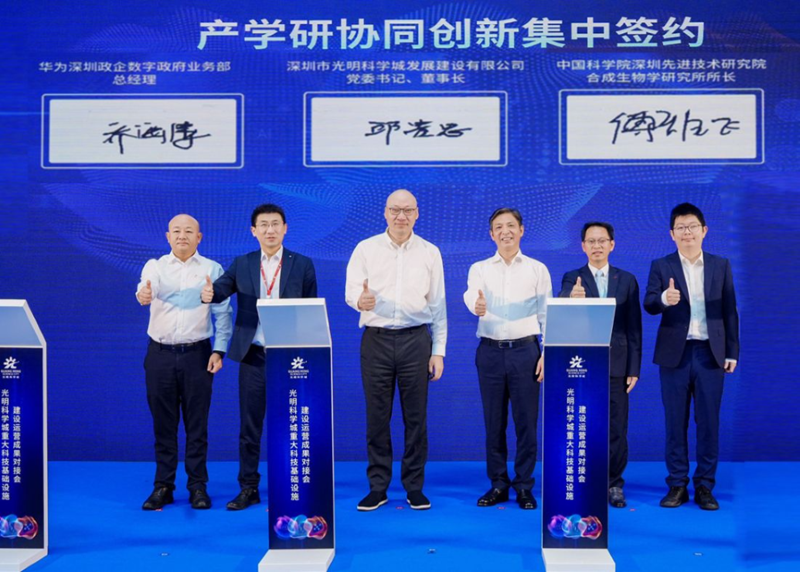
[Synthetic Biology Major Facility Partners with Huawei Computing Power]
Located in northern Shenzhen, Guangming Science City is the core hub of the Greater Bay Area's Comprehensive National Science Center. It already hosts major national scientific infrastructures, including the Synthetic Biology Research Facility and the Brain Computation and Simulation Facility. Among these,The Synthetic Biology Mega-Infrastructure is an automated, high-throughput platform that enables a closed-loop "Design-Build-Test-Learn" iteration.。
However, top-tier research facilities face a common bottleneck:Computing power.
At the core of synthetic biology is treating living organisms as programmable "hardware." Using techniques like gene editing and metabolic pathway design, microbes or cells act as factories to efficiently produce specific substances. This process relies heavily on powerful AI computing power for handling massive volumes of genomic sequence data, predicting protein structures, and simulating metabolic networks.
And that is precisely what Huawei excels at.
What does Huawei bring?
Ascend Computing Power + Pangu Large Model + HarmonyOS Ecosystem
According to the memorandum, the tripartite collaboration will focus on the deep integration of synthetic biology with artificial intelligence and intelligent computing power. Leveraging its unique computing infrastructure, AI large models, and industrial operating system, Huawei is quietly emerging as a key enabler in this trillion-dollar new sector.
Ascend Computing Foundation: Accelerating Large-Scale Synthetic Biology Facilities
The Synthetic Biology Research Facility at Guangming Science City generates terabytes of experimental data daily. Traditional analysis methods often take weeks or even months, whereas Huawei Ascend AI computing clusters can compress massive data processing and model training into hours or even minutes. This enables researchers to complete the "design-test" cycle much faster, significantly boosting R&D efficiency.
Pangu Large Model Empowerment: From "Trial and Error" to "Prediction"
Huawei Cloud Pangu Large Models have mature applications in drug molecule generation and protein structure prediction. In synthetic biomanufacturing, Pangu supports metabolic pathway design, enzyme engineering, and fermentation process optimization. These capabilities will transform synthetic biology R&D from the traditional "trial-and-error" approach to a new paradigm of "AI prediction + experimental validation."
HarmonyOS Ecosystem Link: Breaking Down Data Silos from "Lab to Pilot to Factory"
The "Shenghong" operating system, jointly developed by Guangzhou Bio Island Laboratory, Huawei Cloud, Wanhua Chemical, and Hualong Xunda, has been officially launched. It marks the first introduction of a HarmonyOS-based industrial system into the biomanufacturing sector. In collaboration at Guangming Science City, HarmonyOS is poised to serve as the unified operating system connecting research equipment, pilot-scale facilities, and production lines—enabling end-to-end data integration and ensuring full autonomy and controllability.
Accelerating the Transition of Biomanufacturing to the "Smart Factory" Era
Huawei is not new to bio-manufacturing. Prior to this, Huawei has deepened its collaboration with companies such as GPC, Hengrui Medicine, Hybio Pharmaceutical, MGI Tech, and Wanhua Chemical, covering multiple stages including AI-driven drug discovery, process optimization, and industrial control.
However, the collaboration with Guangming Science City and the Shenzhen Institute of Advanced Technology (SIAT) marks Huawei's strategic shift from "serving individual enterprises" to "empowering the entire industry ecosystem." By connecting national-level research facilities with top-tier institutions, Huawei is building a synthetic biology manufacturing innovation network centered on domestic computing power.
It is clear that in the near future, every new synthetic microbe strain and process developed at Guangming Science City will run natively on Huawei's computing infrastructure. Through this collaboration, Huawei will emerge as an indispensable "Chinese force" in the global field of synthetic biology manufacturing.
Future biomanufacturing plants may no longer rely on traditional fermenters and manual control. Instead, they will become "smart bioplants" powered by real-time AI optimization, unified scheduling via intelligent operating systems, and end-to-end digital twin simulation.。
[ 2026 Yimao Bio-Manufacturing Industry Exhibition ]
The 2026 BIO-TECH Manufacturing Industry Expo will be held grandly in Shanghai from 8/27-28.This exhibition is organized by Yimao Medical. Invited guests will be present on-site, including:2000+Attendee,150+ Speaker,50+Premium exhibitors, featuring "Exhibitions - Products - Conferences - PartnershipsFour core modules focused on "breakthroughs in fundamental research and cross-sector industrialization," establishing a benchmark event for the entire bio-manufacturing value chain.