Shougang Langze's stock price doubles in two days: Can AI + synthetic biology really "turn carbon into gold"?
On 6 3, Beijing Shougang Langze Technology Co., Ltd. officially listed on the Main Board of The Stock Exchange of Hong Kong Limited.
This is not just a routine IPO. Shougang Langze's listing has set at least three new records:The first company in the global CCUS (Carbon Capture, Utilization, and Storage) sector to commercialize synthetic biotechnology, the 7th Hong Kong-listed subsidiary of Shougang Group, and the "Global ESG First Stock" on the Hong Kong stock market.From its inception in 2011 to its listing in 2026, Shougang Group has once again achieved a major milestone in advancing the industrialization of green and low-carbon technologies and empowering real-economy industry upgrades through capital operations.
But behind this dazzling IPO story lies a fundamental shift in the underlying logic of China's bio-manufacturing. In just 15 years, Shougang Langze has proven one thing:Synthetic biotechnology, once deemed "impossible to industrialize," is now transforming carbon-intensive industries into carbon resource factories. 。
From Lab to Factory
A technological breakthrough that was widely predicted to fail.
In 2011, Shougang Lanza was founded amid the green technology wave, introducing a bio-fermentation process that converts industrial off-gas into ethanol. At the time, many in the industry doubted its commercial viability because, although the technology had been successfully developed in the lab, it had not yet undergone pilot testing.
Scaling from the lab to mass production is never a straight line. Shougang Longze has pioneered a globally unique commercial pathway for industrializing waste gas resources. We define ourselves not as a traditional environmental protection company or a single bio-manufacturing firm, but by leveraging“A unified technical architecture integrating CCUS carbon capture as the foundation, synthetic biology as the core process, and AI-driven intelligent control as the engine.,Turn industrial exhaust from the steel and ferrous alloy sectors into valuable resources.
Under the industrial resources and scenario support of Shougang Group, the company has built aGen 1 carbon reduction + Gen 2 negative carbonDual-technology architecture. ThroughAI Big Data Analytics and Simulation ModelsIntelligently optimize strain cultivation, off-gas component monitoring, and the entire fermentation process to continuously improve carbon conversion efficiency. Leveraging proprietary synthetic biology strain technology, industrial waste gas that was previously vented directly is converted via biological fermentation intoHigh-Purity Bioethanol and Novel Microbial ProteinTwo core products that completely break away from the traditional ethanol production model reliant on food crops like corn and sugarcane.
In addition, bioethanol can be further processed intoSAF Sustainable Aviation Fuel, directly supplying the global aviation industry's critical need for decarbonization; microbial protein has secured China's first new feed product certificate, with crude protein content ≥ 80%, effectively replacing imported soybean meal at the source.Ensure national food securityThis IPO will primarily raise funds for Phase II of the Hebei negative carbon project and the construction of a new SAF production line, ensuring alignment between product destinations and capital allocation.
Three elements form a perfect "carbon closed-loop" business model:Emissions originate from our own industrial chain (Shougang Group), value-add pathways are already established (ethanol → SAF, microbial protein → feed), and the fundraising is expanding application scenarios.。
Once fully commercialized, this technology will drive three transformative shifts: carbon emission reductions in the industrial sector, clean fuel alternatives for aviation, and self-sufficient feed protein production.
From Steel Giant to Green Tech Capital
Viewed over a longer time horizon, Shougang Langze's story is not just about a company going public.
Two larger trends are converging behind it. One isChina's "Dual Carbon" Strategydeepening implementation; policy-level encouragement for the integrated development of CCUS technology with synthetic biology and resource recycling technologies; another isSynthetic BiologyAs the most disruptive biomanufacturing technology of the 21th century, it is transitioning from laboratory research to large-scale industrialization, reshaping the paradigm of industrial production.
The industrial revolution under the "Dual Carbon" goals is, at its core, a revolution in revaluing carbon resources. Shougang Langze's listing marks that this revolution has moved from concept to capital validation. From a startup in 2011 to a global benchmark for CCUS + biomanufacturing in 2026, Shougang Langze has proven one thing in just 15 years:When synthetic biology meets industrial applications, turning carbon into gold is no longer science fiction—it's happening now.。
2026 (2nd) EMBC Bio-Manufacturing Industry Conference & Exhibition (Summer)
2026 (2nd) EMBC Bio-Manufacturing Industry Conference & Exhibition (Summer)will be8 27-28Held in Shanghai, the exhibition will invite2000+ Attendees,100+Speaker,20+Premium exhibitors, featuring "Exhibitions - Products - Conferences - PartnershipsFour core modules focused on "breakthroughs in fundamental research + cross-domain industrial implementation."
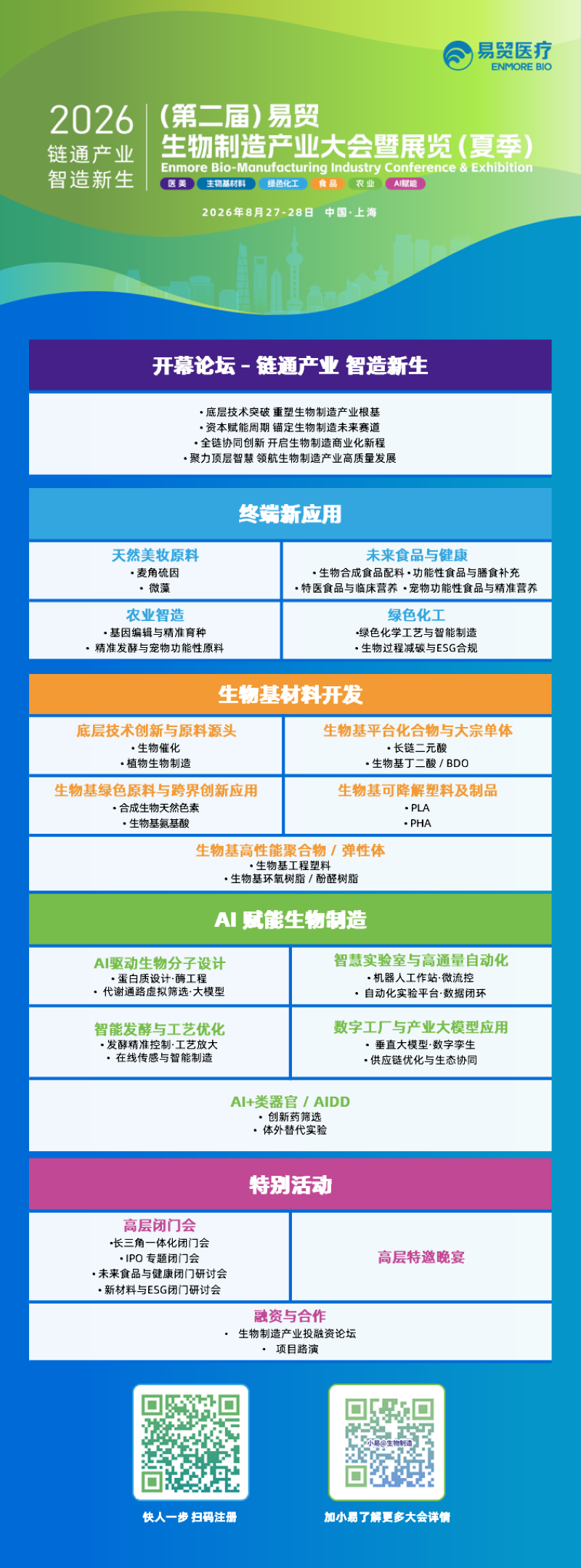
Whether you are an entrepreneur, investor, technical expert, or procurement decision-maker in the bio-manufacturing sector, this exhibition offers a platform to explore the latest policy trends and industry developments, connect with top-tier capital and high-quality projects, and showcase cutting-edge technologies and innovative products.