With leading ministries taking the initiative, Shanghai and Guangdong have successively rolled out new measures. How are other regions supporting bio-manufacturing?
Today, bio-manufacturing is recognized as a core future industry and has been included in the national "15th Five-Year Plan" for key development, with enormous global market potential. Recently,National ministries and commissions, Shanghai, and Guangdong have successively introduced special supportive policies.drive comprehensive efforts across platform construction, model innovation, industry empowerment, and factor supportThe strategic window for the biomanufacturing industry has arrived.。
[National Level: Incubating Pilot Platforms to Bridge the "Last Mile" from Lab to Factory]
On 6 11, the Ministry of Industry and Information Technology (MIIT) and the National Development and Reform Commission (NDRC) jointly issued the "Notice on Carrying Out the Cultivation of Pilot Capacity Construction Platforms for Biomanufacturing." The policy sets clear quantitative targets: by 2027, the goal is to cultivate biomanufacturing pilot platforms.Material Manufacturing Pilot Construction Capability Platform 20 or moreServing over 200 companies and incubating more than 400 products, it effectively supports the full-chain transformation of innovative outcomes from "small-scale validation" to "pilot expansion" and finally to "industrial application."
In terms of cultivation focus, policies prioritize key product areas including food and additives, biopharmaceuticals, cosmetics, chemicals, energy, and enzyme preparations. They also emphasize the development and utilization of new raw materials such as lignocellulose and C1 compounds, along with emerging technical pathways like plant chassis cells.
[Shanghai: 10 Billion Fund + "Virtual Company" Model, Building a "Patient Capital" for Biomanufacturing]
Shanghai's strategy in the bio-manufacturing sector places greater emphasis onEcosystem Building and Capital GuidanceAs early as 2023, Shanghai issued the "Action Plan for Accelerating Synthetic Biology Innovation and Building a High-End Biomanufacturing Industry Cluster," promoting the transformation of synthetic biology technology into a high-end industry cluster through top-level design. Subsequently, the "Action Plan for Accelerating the Construction of Bio-Manufacturing Intelligent Spaces" was released to seize opportunities in the global bioeconomy and accelerate the development of R&D and industrialization hubs. In alignment with China's upcoming 15th Five-Year Plan, biomanufacturing has been designated as one of the key areas leading future development.
The most noteworthy initiative in Shanghai is a comprehensive, multi-pronged execution strategy.
First comes the actual capital investment. In 2025 10,Shanghai Launches First Bio-Manufacturing Industry Fund, with a total scale of 10 billion yuan, byJointly initiated by Daotong Investment and OpphemAdopts a "C+VC" dual-drive model, where industry-leading enterprises collaborate with professional investment firms. The fund has been selected by Shanghai State Investment Company and is now a sub-fund of the Shanghai Pioneer Industry Parent Fund.
Next is the highly innovative "Virtual CompanyMode. Pioneered by the Shanghai Center for Synthetic Biology Innovation, this model selects from a reservoir of concept validation projects across more than 500 cutting-edge fields. After rigorous multi-stage screening and evaluation, it currently funds 14 top-tier projects. The core approach: rather than rushing to establish physical operations, the center provides funding through "virtual companies," assigns dedicated project managers, and conducts comprehensive validation of technology commercialization pathways, market demand, and intellectual property. Successful validations lead to incubation as independent companies; failed ones are absorbed by the center, allowing researchers to return to the lab without financial risk. Industry insiders aptly describe this mechanism as installing an "airbag" for high-risk original innovation.
At the industrial ecosystem level, Shanghai has established a cross-regional closed-loop collaboration.R&D in Zhangjiang, industrialization in Minhang Development Zone—CeliV BioThis is a typical case. Founded in 2013 in Zhangjiang, it has focused on liver regeneration and holds over 100 domestic and international patents. In 2025, it established the world's first clinical registration and industrialization base for liver progenitor cell injections in Minhang. Phase I clinical data showed that all enrolled patients experienced varying degrees of liver function improvement.
Benchmark companies also stand out.。Tianwu TechnologyBuilding a leading AI large model for proteins. Our technology is industry-leading, having developed dozens of protein products for over 30 domestic and international companies, successfully breaking the international technical monopoly.Siyi TechnologyLed the development of the world's first industrial standard for RNA biopesticides, created the world's first RNA fungicide and China's first RNA insecticide, and established China's first pilot-scale production line for RNA pesticide active ingredients.Cathay BiotechBy optimizing the iterative production process for long-chain dicarboxylic acid, we reduced traditional chemical synthesis time by 99% and fully replaced conventional chemical processes with biomanufacturing technology.
[Guangdong: The "Baiyun Model" of a Trillion-Yuan Industrial Cluster]
As a key pioneer region for China's bio-manufacturing industry, Guangdong Province issued the "Action Plan for Accelerating the Construction of an Innovation Hub for Bio-Manufacturing" in early 2025, aiming to establish an internationally competitive bio-manufacturing industrial cluster by 2027 with total output value approaching5000 hundred million yuanMove forward.
Build a strong foundation at the provincial level.In 2026 1, the Guangdong Provincial Department of Industry and Information Technology and the Development and Reform Commission jointly issued "Several Measures to Promote Biomanufacturing for Manufacturing in Guangdong," emphasizing increased efforts in key areas such as core strains, industrial enzyme preparations, and bioreactors. Provincial manufacturing innovation centers meeting eligibility criteria may receive up to 1000 million yuan in funding support, while key cultivars can be granted staged subsidies of up to 3000 million yuan. Additionally, a "Enterprise Demand–Targeted R&D" matchmaking platform was established to foster deep collaboration between enterprises in sectors like food, pharmaceuticals, and chemicals with innovation institutions.
The city-level planning in Guangzhou is clear.Guangzhou has incorporated biomanufacturing into the key cultivation scope of the "12218" modern industrial system, planning to build a biomanufacturing industrial park to establish an innovation hub and high-end manufacturing base with national competitiveness and influence.
Real cash support lands in Baiyun District.As the first district-level comprehensive special policy for biomanufacturing in Guangzhou, "Several Measures of Baiyun District to Promote High-Quality Development of the Biomanufacturing Industry" establishes a full-cycle support system across ten dimensions: manufacturing, innovation, application, finance, and more. Leading enterprises can receive up to1500K RangeFunding support for level-level funds, providing separate grants to national and provincial bio-manufacturing pilot platforms that have been certified.500 ten thousand yuan, 300 ten thousand yuanSupport: Relevant enterprises can receive up to800 ten thousand yuanDistrict-level funding support. Baiyun District is accelerating the construction of a bio-manufacturing industrial park spanning over 1,000 acres. Phase I (450 acres) focuses on the biopharmaceutical and beauty industries, while Phase II (900 acres) expands to five industrial clusters. Supported by a bio-manufacturing fund cluster totaling 100 billion yuan, the district aims to achieve an industry output value exceeding [target] by 2028.500 hundred million yuan。
From national efforts to strengthen industrial foundations, to Shanghai's exploration of innovative incubation models, and Guangdong's full-scale implementation aimed at industrial scale, bio-manufacturing has entered a golden era of nationwide collaboration and multi-point growth.
Continuous policy benefits, combined with comprehensive support in technology, capital, scenarios, and platforms, ensure that startups, SMEs, and industry leaders can all find relevant support opportunities.The policy window for biomanufacturing is now fully open. Who emerges first from this wave of opportunity won't depend on luck—it will depend on execution.
2026 (2nd) EMBC Bio-Manufacturing Industry Conference & Exhibition (Summer)
2026 (2nd) EMBC Bio-Manufacturing Industry Conference & Exhibition (Summer)will be8 27-28Held in Shanghai, the exhibition will invite2000+ Attendees,100+Speaker,20+Premium exhibitors, featuring "Exhibitions - Products - Conferences - PartnershipsFour core modules focused on "breakthroughs in fundamental research + cross-domain industrial implementation."
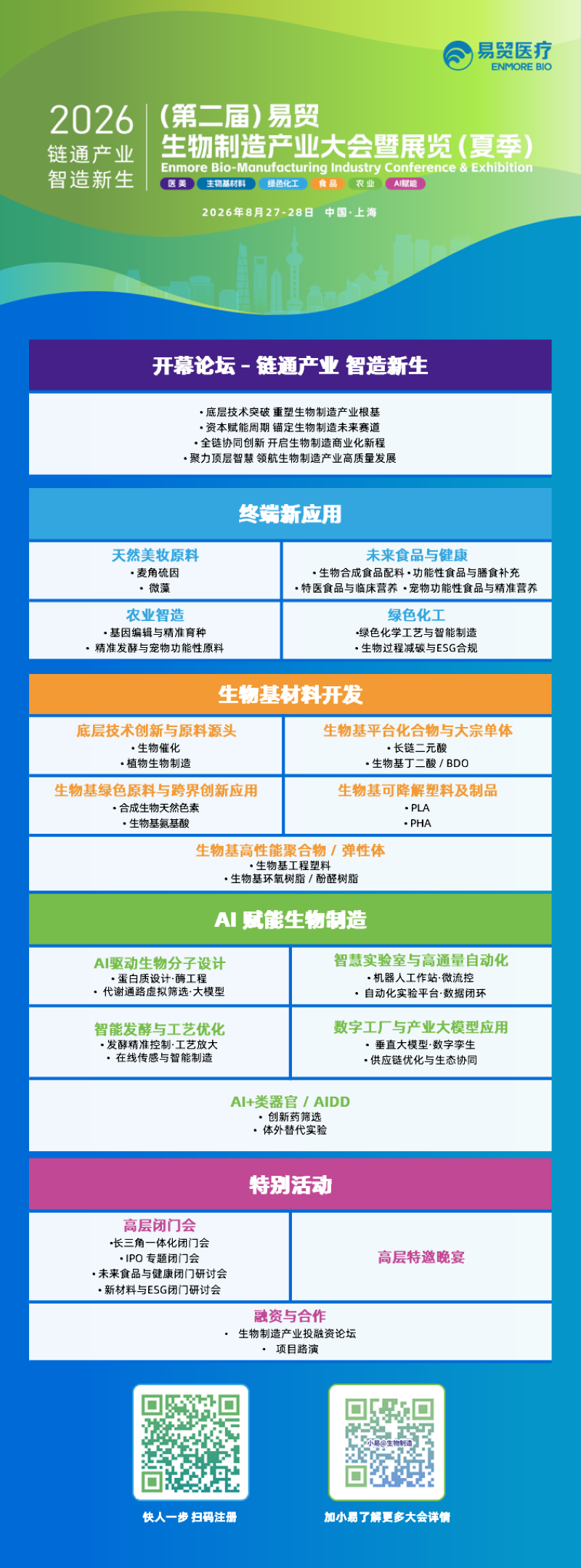
Whether you are an entrepreneur, investor, technical expert, or procurement decision-maker in the bio-manufacturing sector, this exhibition offers a platform to explore the latest policy trends and industry developments, connect with top-tier capital and high-quality projects, and showcase cutting-edge technologies and innovative products.